
Blog
Survey: how Croatian companies are adopting AI in 2026
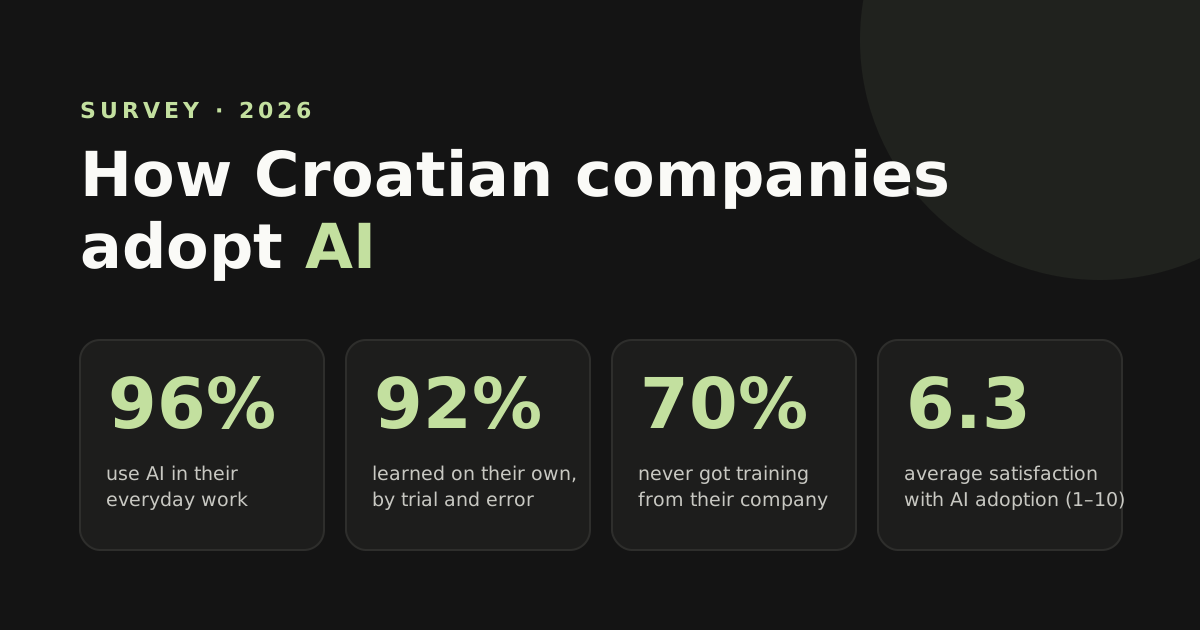
How are Croatian companies adopting AI? We asked employees and managers: 147 respondents, 73 of them managers (team lead and above), across 21 questions.
The short answer: employees already use AI every day, but companies mostly aren't guiding them. There's no one in charge, no training and no measurement. And where those things do exist, people are considerably more satisfied.
1. AI is already part of everyday work
96% of respondents (138 of 143) use AI in their everyday work. Not for one thing, but on average for 6 to 7 different kinds of tasks. Most often for code (84%), research (76%), writing and editing text (70%) and data analysis (68%).
The question is no longer whether people will use AI, but how well they use it.
2. People learn on their own, companies don't train them
92% learned AI on their own, by trial and error. Only a minority use channels provided by the company: internal training 26%, and an external course paid for by the company just 7%.
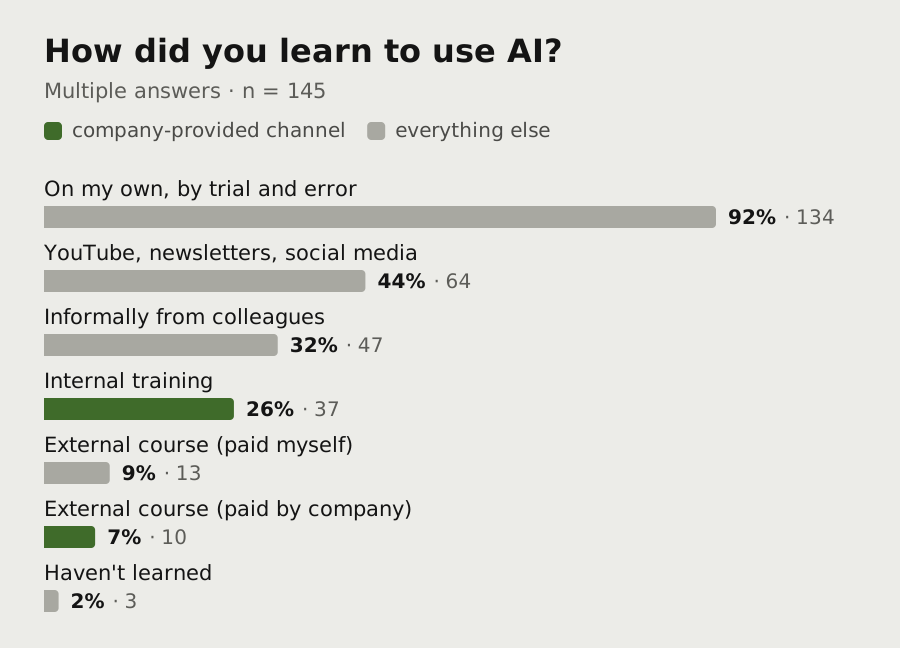
An interesting detail: more people paid for an external course out of their own pocket (13) than had their company pay for it (10).
In total, 70% of respondents have never received any training from their company. Where training exists, it's most often a one-off workshop or webinar.
3. AI adoption has no owner and no measurement
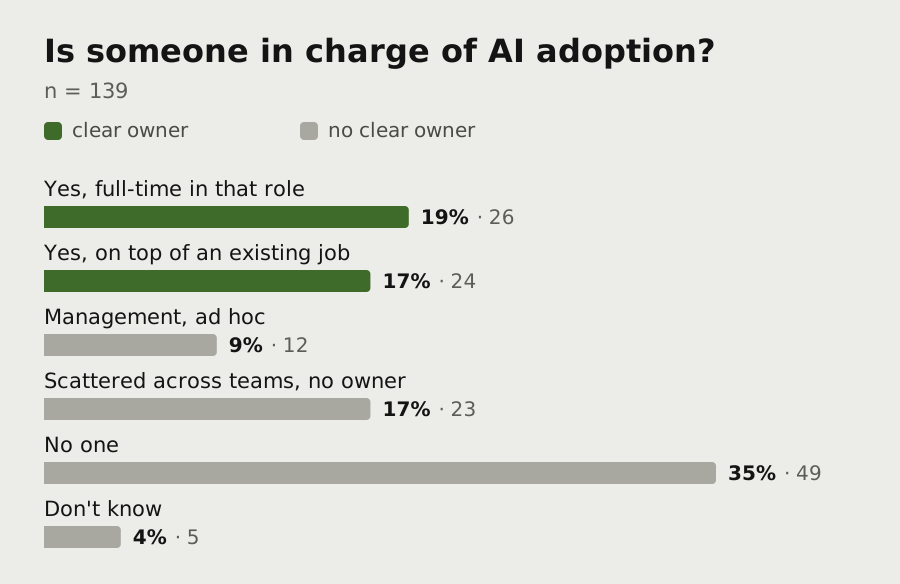
64% say no one is clearly in charge of AI adoption. Only 19% have someone whose full-time job it is.
Measurement isn't any better. 45% of companies don't measure AI use at all, and only 28% measure it and share the results with employees. When managers do measure success, they mostly look at time saved (79%), and only 38% look at financial return on investment.
4. Budgets are small, and everything is done in-house
Half of the managers say their company has an AI strategy (31 of 63). But in half of the companies, the budget for AI tools and training is under €5,000 a year, or there's none at all.
As many as 85% of companies do everything in-house. Only 9% have hired an external partner for AI adoption.
Still, things are moving: 51% of managers plan to invest in AI training in the next 12 months, and 12 already have an approved budget.
5. Satisfaction depends on organisation, not tools
This is the most important finding of the survey. Respondents rated how satisfied they are with the way their company is adopting AI (1 to 10). The average is 6.3.
We then looked at four practices: a person in charge, training, measurement with shared results, and an active internal community (a channel or group for swapping AI tips). The result is very clear:
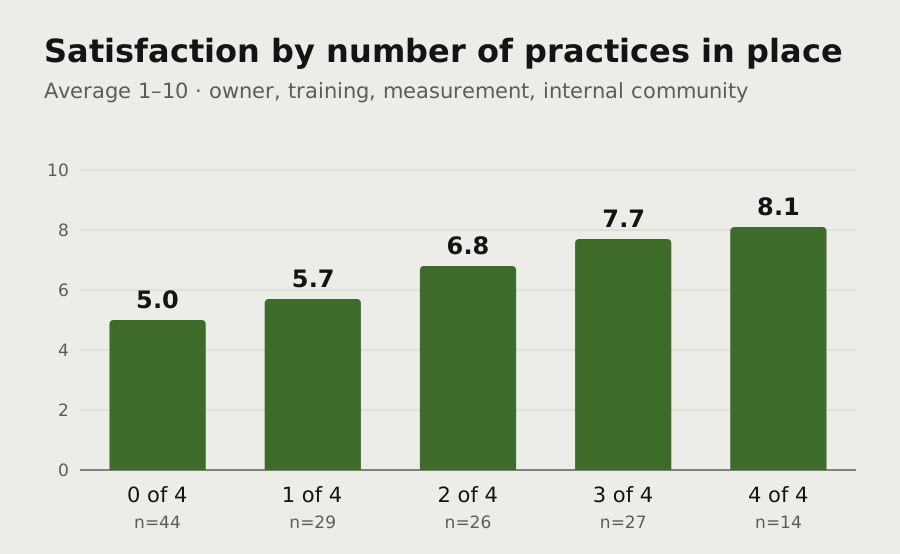
Where none of the practices exist, average satisfaction is 5.0. Where all four exist, it's 8.1. Each additional practice adds roughly 0.8 points.
Each practice on its own shows the same picture:
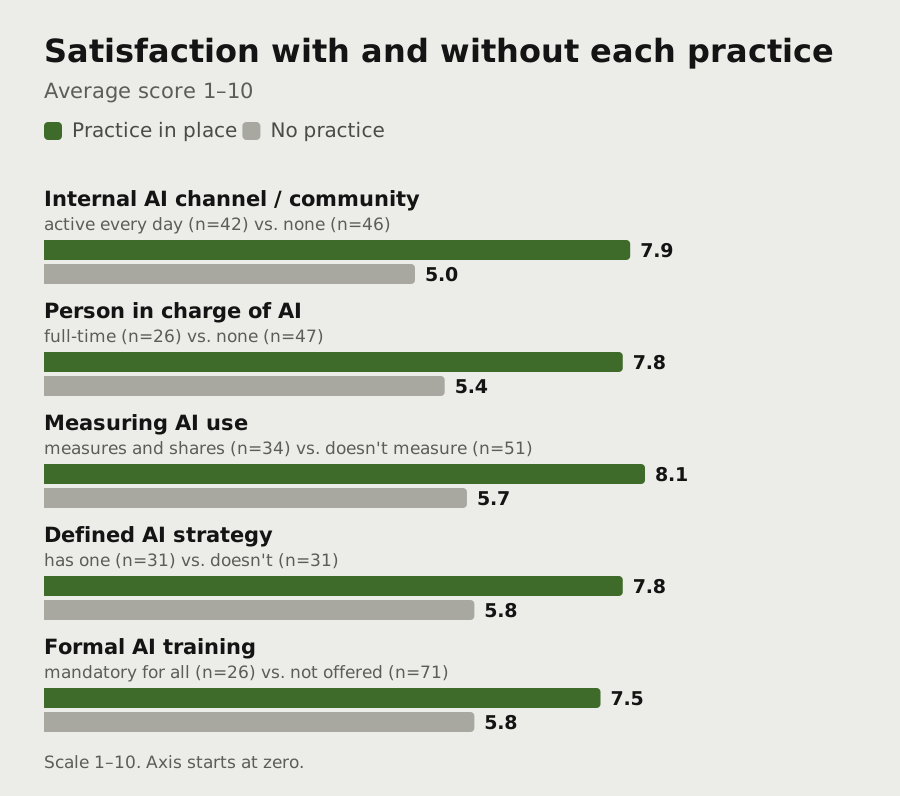
The biggest differences come from a lively internal community (+2.9) and a full-time person in charge of AI (+2.4).
One caveat: this is a correlation, not proof that the practices cause satisfaction. Companies that introduce these practices probably differ in other ways too.
6. The view from the top is rosier
Leadership is more satisfied than the rest of the company. C-level gives an average score of 7.4, while team leads and individual contributors give 6.0.
By company size, the curve is U-shaped. Small companies are flexible, large ones have resources, and mid-sized ones have neither:
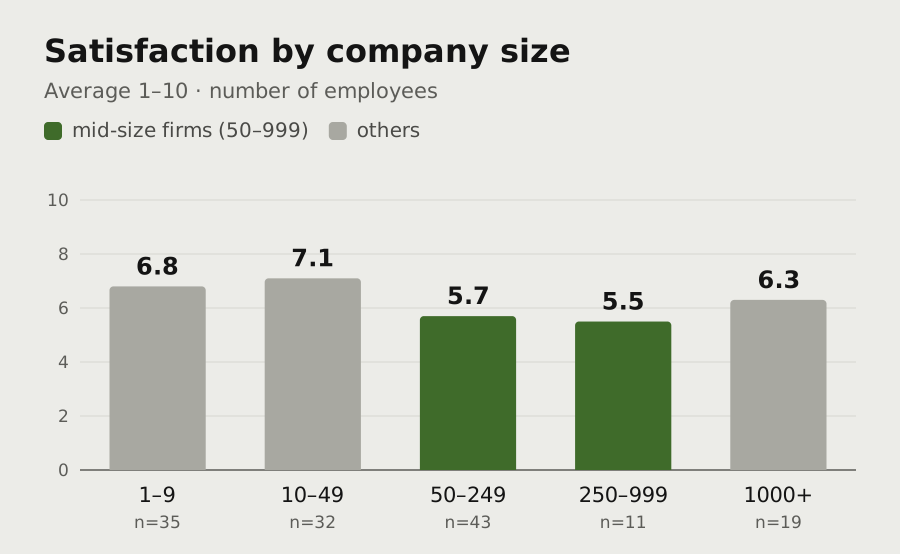
In companies with 50 to 249 employees, where most respondents come from, the gap between need and support is the largest.
7. Time and trust hold people back, not rules
What would help people use AI more? At the top are time to learn (34%) and trust in the accuracy of answers (30%). Only 8% ask for clear rules on what they're allowed to do.
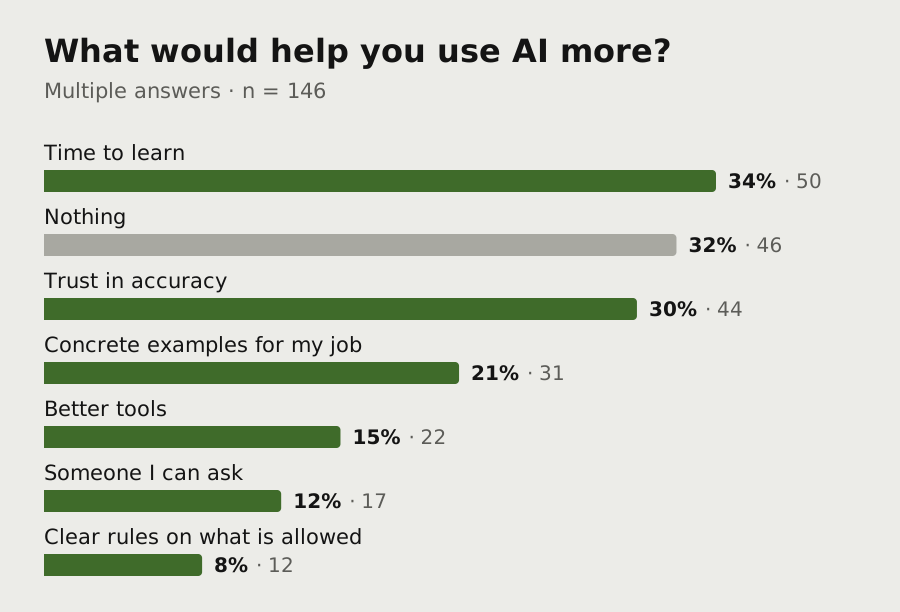
So what holds people back isn't "am I allowed to?", but "is it worth it, and can I rely on the result?". A third (32%) say they don't need anything, which fits a sample with many advanced users from IT.
What it means for your company
The results point to five steps that don't require a big budget:
- Name an owner. It doesn't have to be full-time, but someone has to be responsible.
- Measure and share the results. Measurement that employees never see changes almost nothing.
- Feed the community. An active internal channel turns individuals' self-learning into company-wide knowledge.
- Train on concrete tasks and give people time to learn. Rules on their own don't help.
- Build trust in the results. Teach people how to check what AI writes.
About the survey
- Sample: 147 complete responses collected via Typeform. Questions on strategy, budget, ownership, measurement and external partners were shown only to team leads, directors and C-level (73 respondents).
- Percentages are calculated on the number of people who answered each question. For multiple-choice questions the total exceeds 100%.
- Structure: 75% of respondents who named their industry come from IT and software. The sample is a convenience sample and probably skewed towards more technologically advanced companies, so actual adoption across the wider Croatian economy is probably lower.
- Small groups: results for groups with fewer than 15 respondents (e.g. companies with 250 to 999 employees, n = 11) should be read as indicative.